
This Tuesday, February 10th we discussed “thinking models” in class. The two I chose to compare are Gibbs’ Reflective Cycle, which I used last year, and Boud’s Reflective Triangle, which is new to me. Today I have decided to try Boud’s model to reflect on a personal experience, simply because I think it is good to try new things and I would like to understand it better before choosing a favourite. The infographics below explain each model:
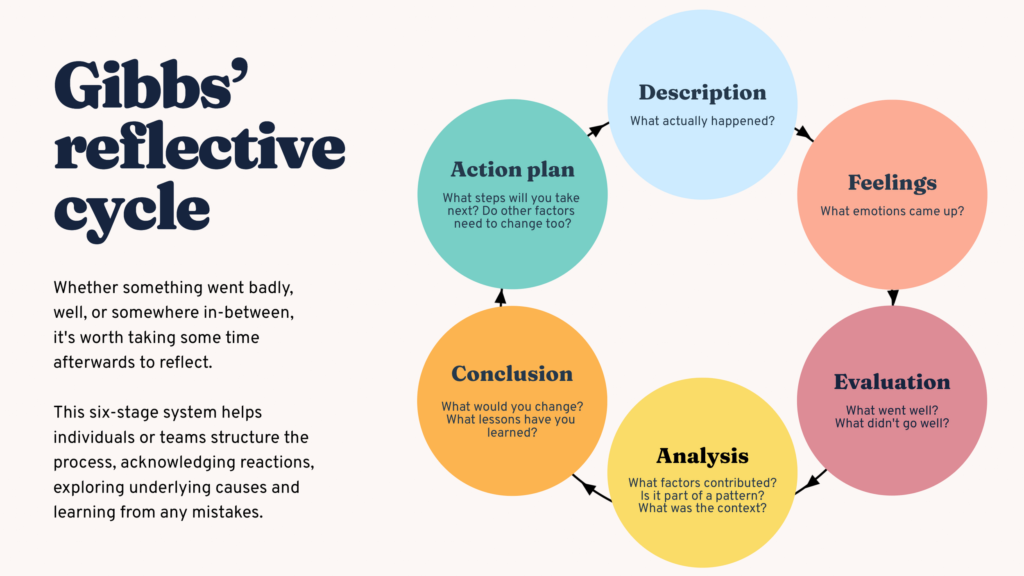
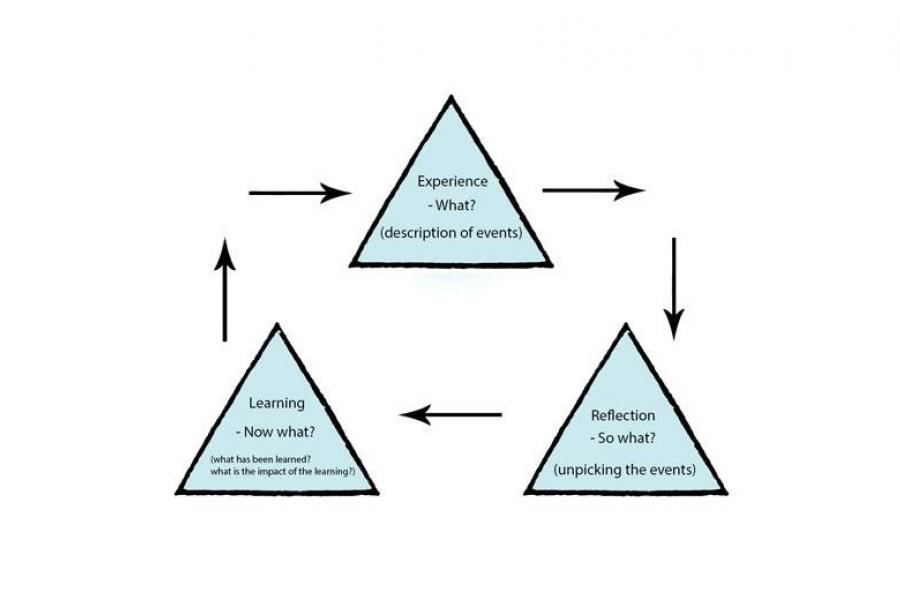
The models are based on a similar premise of reflecting using the past, present, and future in a cycle that eternally repeats as we grow (remember, us teachers are lifelong learners!). The primary difference that I noticed right off the bat is that Boud’s Reflective Triangle involves many less steps and reflective prompts than Gibbs’ Reflective Cycle does. As I looked more, I noticed some pros and cons to each model, which are as follows:
Gibbs’ Reflective Cycle- pros
- Includes very explicit prompts, which may help some users start their thinking when they feel unsure of which details are important to share
- Encourages the user to recognize their emotional response to an event (which many people will not do unless directly asked in this way)
- Encourages the user to think broader than the scope of their immediate experience (e.g., “What was the context?” and “Is it part of a pattern?”)
Gibbs’ Reflective Cycle- cons
- There are some stages that are similar to the point where a user may not be able to provide a meaningfully distinct response to each of them (e.g., in simple scenarios “evaluation” and “analysis” or “conclusion” and “action plan” could be responded to in the exact same way)
- The fact that this model is so highly structured might prohibit some users from thinking creatively or drawing connections between the stages that make sense to them (e.g., some users might only be able to put their feelings about an event into words after analyzing it, which is opposite to the clockwise flow of the model)
Boud’s Reflective Triangle- pros
- The stages are laid out very simply with clear guiding questions, which may be more inviting and easier to start than larger and more complex thinking models (such as Gibbs’)
- The stages are easy to remember, so a person would be able to mentally use this model and ‘take it with them’
- The stages are distinct enough that there is no overlap between them, eliminating excess work
Boud’s Reflective Triangle- cons
- Because the prompts in the model are so open, some people may struggle to decide what pieces of information are relevant in their reflection and miss important details to learn from
- I think that it can be very valuable to look at an experience separate from the emotions that I had during it, and this model does not encourage that
- I also think it is so valuable to decide what to do (or not do!) in response to new learning, and this step is only hinted at (“what is the impact of the learning?”)
Below is my first try at using Boud’s Reflective Triangle to organize my own thinking. I would probably prefer to use Gibbs’ Reflective Cycle to process events that were more complex than this one, but for a small experience like this, I found Boud’s model efficient and effective. Thinking back on this experience of deciding what to tell a student who was eating a (potentially) unsafe plant, I realize now I was encountering a difference in worldview in some ways (UVic teacher competency: “develop an awareness of your worldview and how this relates to others’ worldviews“). In a “traditional” public school, students likely would have been told they were not allowed to pick anything, regardless of their planned use for it. At this school, students had the understanding that it was their responsibility to only take what they needed, to use it all, and to not take something from nature if there wasn’t enough left to replenish itself. In this moment, and in this specific context, I had to consider how reasonable my discomfort about a student potentially eating an unsafe plant was. In the end, I feel that I did a reasonable job and have an idea of how to approach the situation next time.

Graham,
I appreciate you trying out Boud’s reflective triangles! (Glad to know that the student’s actions left him/her/them unscathed! )
Thinking models can become quite academic, but they set the stage with regards to infusing the practice of self reflection into your teaching practice.
Cheers.