Category: EDCI 330

EDCI 330 Reflection #3 (thinking models): Gibbs’ Reflective Cycle vs. Boud’s Reflective Triangle

This Tuesday, February 10th we discussed “thinking models” in class. The two I chose to compare are Gibbs’ Reflective Cycle, which I used last year, and Boud’s Reflective Triangle, which is new to me. Today I have decided to try Boud’s model to reflect on a personal experience, simply because I think it is good to try new things and I would like to understand it better before choosing a favourite. The infographics below explain each model:
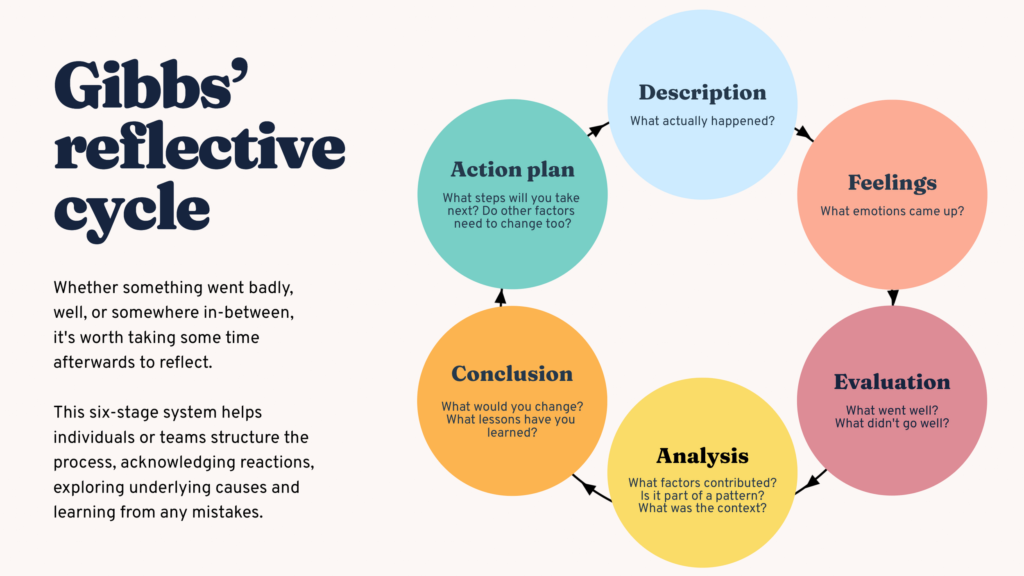
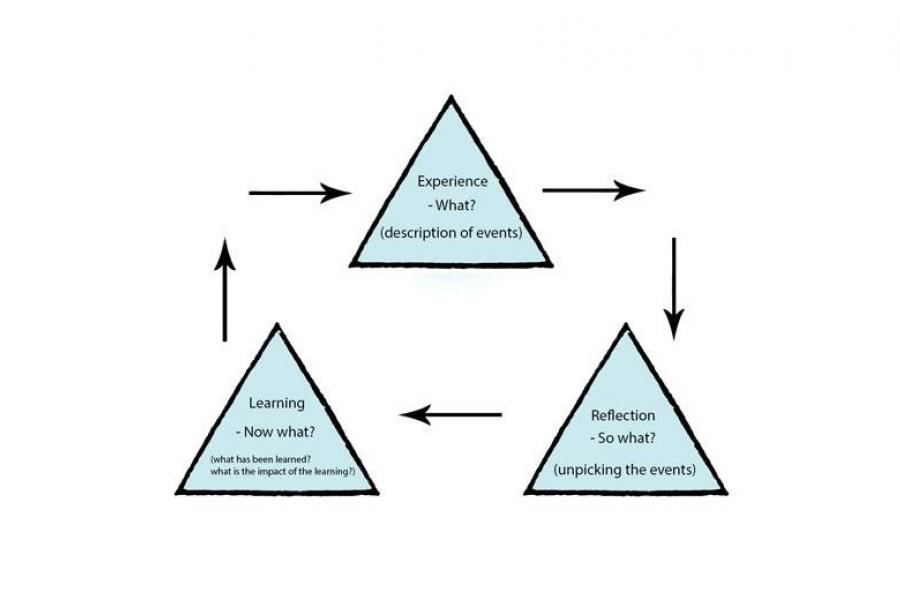
Image credit: BiteSize Learning https://www.bitesizelearning.co.uk/resources/gibbs-reflective-cycle-explained-diagram-examples
Image credit: University of Manitoba https://umanitoba.ca/centre-advancement-teaching-learning/support/reflective-teaching

The models are based on a similar premise of reflecting using the past, present, and future in a cycle that eternally repeats as we grow (remember, us teachers are lifelong learners!). The primary difference that I noticed right off the bat is that Boud’s Reflective Triangle involves many less steps and reflective prompts than Gibbs’ Reflective Cycle does. As I looked more, I noticed some pros and cons to each model, which are as follows:

Gibbs’ Reflective Cycle- pros

  • Includes very explicit prompts, which may help some users start their thinking when they feel unsure of which details are important to share
  • Encourages the user to recognize their emotional response to an event (which many people will not do unless directly asked in this way)
  • Encourages the user to think broader than the scope of their immediate experience (e.g., “What was the context?” and “Is it part of a pattern?”)

Gibbs’ Reflective Cycle- cons

  • There are some stages that are similar to the point where a user may not be able to provide a meaningfully distinct response to each of them (e.g., in simple scenarios “evaluation” and “analysis” or “conclusion” and “action plan” could be responded to in the exact same way)
  • The fact that this model is so highly structured might prohibit some users from thinking creatively or drawing connections between the stages that make sense to them (e.g., some users might only be able to put their feelings about an event into words after analyzing it, which is opposite to the clockwise flow of the model)

Boud’s Reflective Triangle- pros

  • The stages are laid out very simply with clear guiding questions, which may be more inviting and easier to start than larger and more complex thinking models (such as Gibbs’)
  • The stages are easy to remember, so a person would be able to mentally use this model and ‘take it with them’
  • The stages are distinct enough that there is no overlap between them, eliminating excess work

Boud’s Reflective Triangle- cons

  • Because the prompts in the model are so open, some people may struggle to decide what pieces of information are relevant in their reflection and miss important details to learn from
  • I think that it can be very valuable to look at an experience separate from the emotions that I had during it, and this model does not encourage that
  • I also think it is so valuable to decide what to do (or not do!) in response to new learning, and this step is only hinted at (“what is the impact of the learning?”)

Below is my first try at using Boud’s Reflective Triangle to organize my own thinking. I would probably prefer to use Gibbs’ Reflective Cycle to process events that were more complex than this one, but for a small experience like this, I found Boud’s model efficient and effective. Thinking back on this experience of deciding what to tell a student who was eating a (potentially) unsafe plant, I realize now I was encountering a difference in worldview in some ways (UVic teacher competency: “develop an awareness of your worldview and how this relates to others’ worldviews“). In a “traditional” public school, students likely would have been told they were not allowed to pick anything, regardless of their planned use for it. At this school, students had the understanding that it was their responsibility to only take what they needed, to use it all, and to not take something from nature if there wasn’t enough left to replenish itself. In this moment, and in this specific context, I had to consider how reasonable my discomfort about a student potentially eating an unsafe plant was. In the end, I feel that I did a reasonable job and have an idea of how to approach the situation next time.


Image credit: author, created using Canva

EDCI 330 Reflection #4: “Where I’m From” poems… Where am I from, and how much does it matter?

“So long as you think you are white, there is no hope for you.”

-James Baldwin

This week, we had a special guest in class who invited us to revisit an activity that many people have done in elementary school: an ad-libbed version of George Ella Lyon’s 1993 poem “Where I’m From”. She gave a wonderful talk, and finished it by handing out templates of this poem for us to fill in using details from our own lives. I thought this activity was a good balance of structured and creative, and I see a lot of value in encouraging students to consider where, who, and what they are from. I think of how common it is for Canadians who are People of Colour to be asked “where are you from?” with thinly-veiled malice, and with an unearned sense of white entitlement to places. I would like to think that reminding students that everyone is “from” somewhere unique, that many of us came as immigrants/colonizers (even if it was generations ago), could help disrupt this way of thinking.

Image credit: Unsplash

Now, back to that James Baldwin quote I used to grab your attention: I agree with the sentiment that whiteness, as an identity, needs to be abolished. I was initially put onto this idea by reading Noel Ignatiev’s work, which asserts the same thing. This article I read a few years ago sums his work up well, especially in this particular quote:

“Reading his work and that of his colleagues, it becomes clear that almost every element of white identity that one might want to preserve is already contained in other identities – ethnic, religious, national, cultural – which do not inherently marginalize and dominate others and whose positive characteristics are diminished rather than augmented by association with whiteness.”

-Mark LeVine, on Noel Ignatiev’s legacy

I want to present this option to my students, that just because they are white does not mean they have anything meaningful in common, or that they’re part of a big enough club to justify their shared norms being the norm in the classroom. I would love to help white students accept that just like “everybody else”, they are descended from diverse and complicated ancestors, each of which made foods that a classmate may call “weird” if brought to school for lunch today. I remember the one time my mum made Scottish mince for dinner, and I was embarrassed to bring it to school because it looked ugly (it is, and it’s fine) compared to my classmates’ Lunchables. It didn’t help, either, that I probably brought it in a pasta stained Tupperware that was as old as me.

Image credit: author. Description: author and sister playing on the way to visit family

I feel awkward bringing up times like the Scottish mince lunch, because moments like that were minuscule blips for me, a microbe compared to the planet-sized experiences of students who are Children of Colour or recent immigrants. I’m Canadian, it’s only my ancestors from four generations back that were truly Irish and Scottish, and last thing students need is another educator who centres their teaching around white people’s feelings. At the same time, maybe students need a teacher who is willing to “engage critically and creatively with ideas to be a change agent in society, especially with regard to equity and justice”– emphasis on critically. Imagine if I told students the truth, that my Irish ancestors betrayed their Black American and Canadian neighbours to gain access to the benefits of white supremacy? Maybe students would know how flimsy and fake whiteness was if they knew that there was a point where my palest ancestors were not considered white like their British-Canadian neighbours. I am not certain yet how to go about the conversations that will come up from teaching rooted in these ideas, but I am going to figure that out because I think all Canadian students benefit from knowing these complex truths.

And in case you were wondering, here is my “I am From” poem:

I am from polar fleece PJs

From Stanley thermoses and my mum’s curls

frizzy, beautiful, warm

I am from Creeping Jenny,

bright and scented like chlorophyll

I’m from “Galway Girl” and loud laughter with cousins

From Marilyn and Louise

I’m from the love and nagging

From “strong calves” and “no meat on your bones”

I’m from a two-century old bible, but before that, from Danu and the Cailleach

I’m from Lheidli T’enneh homelands and places I’ve never met

canned salmon, potato bread

From cedars so big, you can lay in the cut before falling them

EDCI 330 Reflection #5: Bringing back risky play (or, just playing)

This week, we discussed early childhood education and the importance of play- not just for early childhood, for students of all ages. I really enjoyed Alex Elliot Lockhart’s TED talk about play, which is embedded below. The thing I appreciated the most about it is that, at the core, Alex is telling the audience that sometimes students know best. In my teacher education I have been taught this theory across many subjects, but I feel like I have rarely seen teachers fully implement that theory. I think as teachers we are afraid to let go, because although we may know in our heads this isn’t true, part of us still believes that teachers are the sole experts in the classroom, that they control how and when learning happens.

I think another reason that teachers may struggle to let go and simply let kids play is external pressures. There are deadlines to be met, the provincial curriculum, caregiver expectations, standardized tests, and goodness, I haven’t even mentioned rehearsing synchronized hand gestures for “Grandma got run over by a reindeer” in the upcoming Christmas concert! Then there’s liability and safety: what if a student is hurt climbing a tree under your supervision? What if they damage the new sneakers their parents struggled to buy? What if a younger student copies their tree ascent and falls?

Image credit: Unsplash

I can recall the painful childhood injuries of myself and peers from engaging in “risky play”, or as I knew it, “play”. I distinctly remember when my classmate dislocated his shoulder playing red rover and the paramedics came down into the field to pop it back in, or something like that (I’m not a doctor, guys). My classmates and I were so frightened, we agreed to a new set of rules of our own invention to prevent this from happening again. Unprompted by adults, we evaluated our decisions, created a better plan, and tested it. We realized that really, there wasn’t a good way to to safely enjoy this game, and most of us stopped playing it. Still, that was the last injury that I recall happening from red rover.

If I am to “develop an understanding of how learners learn in order to cultivate effective learning environments”, it seems obvious to me now to “let go” sometimes and give students the chance to simply play in class. I watched my mentor teacher do this last year, and the complex ideas students generated while playing were not only fascinating, but informed my interactions with them. I am glad to be coming into this profession in a time where research is being produced that confirms the importance of good old fashioned play. I look forward to the challenges, bandaids, and big conversations that will inevitably come with this trend in education.

EDCI 330 Reflection #2: What is low-risk?

In this week’s class on January 13th, we discussed “low-risk” soft starts. I got some nice ideas for laid-back activities to start the school days, such as colouring, stacking card towers, or doing puzzles. My (adult) classmates and I enjoyed these activities so much that when it was time to get back to the real work, we requested a few more minutes of puzzle time and agreed to come back and finish it later. This reminded me of my math course last semester, where our instructor suggested puzzles such as tangrams and sudoku for soft starts, and as a mental “warm up”.

Image credit: Unsplash

The key idea of our soft start exploration this week is that to be low risk, an activity must not require skills that students do not yet possess, or push them out of their comfort zone. This made me think about how subjective of a term “low-risk” is, as I considered my own experience in elementary school. I always felt that art was a low-risk activity as a child, because I did not experience criticism for it and I truly enjoyed it. Many students at that age felt similarly about the chance to freely toss a basketball back and forth- something we would do during physical education occasionally, determined to be a “fun and laid back” activity by my teacher. But free play with basketballs did not feel fun and laid back to me, because I didn’t engage with sports outside of class and felt unsure of how to participate. Funny enough, this isn’t the first time I’ve written about how nervous basketball makes me in a course reflection… you’d think I have some sort of “basketball-induced trauma”, but I think that sensitivity was just the social risk I felt as a child (and yes, I am still a bit sensitive).

Image credit: Unsplash

Anyways, I am now questioning what is truly a low risk-activity: does it simply feel low risk to me as the teacher, or is it actually without social or emotional consequences for students? And further than that, given how unique each student is, is it even possible to design a purely risk-free activity? Probably not, which reminds me of the relevance of this UVic Teacher Competency: “demonstrate an understanding of the complexity of teaching and learning”. We can have all the knowledge in the world of our students and the ideal learning scenarios to provide for them, but due to conflicting needs and restraints, we can not always implement what we know would be ideal. However, if I choose a diverse enough selection of soft starts so that each student- even if not simultaneously- has the chance to engage without risk once in a while, I think that will be just fine. I also wonder if what each student feels is “risky” is conditioned, the way it seemed with my younger self and basketball. Art feels risky to some students because, as my classmate once pointed out to me, many teachers (and as I have noticed, some students) are attached to the idea that there is a right and wrong way to create art, and will intervene with “helpful advice” when students are making art that does not look like what the teacher is envisioning. I wonder how I can help condition my future class to not feel unnecessary risk when participating in soft start activities that are meant to be fun? Going forward, I will try choose low risk soft-start activities, while considering that sometimes experiences with teachers and peers have as much effect on what feels risky to a student as the activity itself does.

EDCI 330 Reflection #1: Teacher Worldview

Image credit: Unsplash

“In all affairs it’s a healthy thing now and then to hang a question mark on the things you have long taken for granted”

-Bertrand Russell

Teacher Identity

  • What does it mean to be ‘effective’?

I feel that to be effective as a teacher is to strike a balance of delivering the highest quality of learning for the most students, while not spreading yourself too thin. I have a suspicion (held by others, as you’ll see in this BBC article) that in women-majority careers like teaching, extra unpaid labour is an expectation- not just of women, but of all teachers to varying degrees. I imagine this contributes to the high rate of burnout and of leaving the profession, and I’m sure we can all agree that a burnt out teacher (or one who has left teaching to become a dentist) is no longer an effective teacher. I firmly believe that effective teachers set boundaries and put themselves first so they have more to give.

  • What characteristics does an effective teacher have?

Effective teachers are self-confident, because they prepare in advance and remain flexible when change arrives. They are also self-confident because they know that even if things “go wrong” in the classroom, they are capable of remediating it. This is because they have strong subject matter knowledge in what they teach, and strong interpersonal skills. This confidence allows students to have trusting relationships with teachers, and those trusting relationships let teachers do their job more effectively. Effective teachers are so many other things too: gentle, fair, respectful, attentive, honest, caring, humble, reflexive, open-minded, loving, creative, resourceful, hard-working, and dedicated. I think that for elementary and middle school teachers in particular, a key ingredient to effectiveness is being fun and being able to have a laugh. And last of all, an effective teacher is someone who knows you can’t pour from an empty cup.

  • What kind of teacher do I want to become?

I want to become a teacher that is kind, that takes good care of myself and my community, and as I’ve decided most recently, a teacher that is fully myself. That last one may sound odd, aren’t I already “myself”? What I mean by this is that I do not want to have a professional identity that doesn’t represent who I really am. Because I am a nonbinary person, sometimes I feel uncertain about how to present myself in schools. What do I wear? How do I introduce myself? What do I say when students ask me what my pronouns are or why I “look like a boy”? I used to be afraid to answer these questions, and would spend so long getting dressed for in-situs for fear of looking “too unconventional”. I am finding ways to balance these anxieties with the knowledge that if a school can not support me being who I am, it is not a school I am meant to teach at. In other words, I want to be confident in myself.

  • What do I need to learn to become an effective teacher?

I need to learn to develop a work-life balance, especially since I have struggled with this in the past. I also believe classroom management strategies will be crucial, particularly the ones learned and practiced through experience. I will need to learn strategies to support EAL (English as an Additional Language) learners, and to adapt day plans or lesson plans on short notice.

  • What are my beliefs about teaching (my teaching philosophy)?

I believe teachers have to be strong leaders, as they have the responsibility of cultivating safe, loving, and informed communities. This includes being positive role models, supporting fellow teachers, protecting students from harm, and helping students develop the tools necessary to live the lives they wish. I think teachers must be committed to curiosity, which means not just accepting new information, but actively seeking to understand the world and to learn and share truths.

Reflection

  • What is a worldview?

I think of each person’s worldview as the set of their answers to the “big questions” in life (which of these questions are asked can differ depending on one’s worldview, so perhaps my definition needs some work). Some examples of what I believe to be the “big questions” are: “What is your purpose in life?” “How did the universe come to be?” “What happens after you die?” “What is right and wrong?” “What is normal?” “Who is most important in the world, and in what order?” and “How can we determine what is true?”.

  • How would you describe your worldview?

I would partly describe my worldview by sharing things are very important to me: Indigenous sovereignty and Indigenous rights, antiracism, women’s rights, disability justice, queer rights, and environmentalism. I carry these ideas with me when I make decisions about spending money, voting, choosing words, and traveling; They affect my decisions and perspectives even when I am not consciously thinking about them, although it was not always that way. The layers of my worldview that I see as more inherent are European/settler Canadian, colonial, agnostic, spiritual, and politically left-wing.

  • While thinking about your own worldview, also consider the impacts of your ethnocultural, socioeconomic, geopolitical and spiritual identities.

I am a white person who is descended from Irish and Scottish colonizers. I was raised by a loving, middle-class, white family who identifies mostly with “Canadian” culture, although we feel slightly connected to Irish and Scottish cultures too. Because of this, I turn to history and folklore (rather than religion) for spiritual answers, and being a good host with a tidy home and sense of humour is important to me. My grandparents have taught me that we value hard work, financial independence, formal education, and toughness through difficult times. I grew up in a suburb surrounded by people with very similar identities and upbringings to me, so I inaccurately view myself as the “default” much of the time.

  • Why, as a teacher, is it important to be aware of your own worldview, as well as those of your students and school community?

It is essential for me to be aware of my own worldview because it affects what material I choose to teach, when and how I teach it, who I choose to learn from, who I include my classroom, and how I carry myself. In my school community, every person deserves to feel understood and respected, and understanding and respecting their worldviews demonstrates that.

  • What can you do, as a teacher, to ensure that your worldview does not impede the success of the diversity of learners in your classroom?

To do this, I can choose to honour the responsibility of being a lifelong learner every day, by remaining curious and always being prepared to change. I can read, listen, and watch media and have conversations to advance my understanding of others’ worldviews, and I can do the same to examine the parts of my own worldview that I am blind to or accept as the norm.

  • When do you consider it to be necessary to challenge the western worldview as it impacts the K-12 education system?

I consider this to be necessary every day, in every subject, and in how I carry myself as a teacher both in and out of work.

  • What aspects of the BC curriculum reinforce or challenge a western worldview?

An overarching aspect of the BC curriculum that is very western is the fact that each subject is divided into a separate category, and each grade is separate as well. Another is that English and French are prioritized, while languages that are not European in origin only become available in grade five. Indigenous languages are virtually non-existent in the curriculum. The Applied Design, Skills, and Technology curriculum reinforces capitalist (typically western) values as well. I see that there are many areas where Indigenous topics, knowledge, and subject matter are included or even inform the broader curriculum design, but I do not feel that it is actually challenging the western worldview. I think it is more of a tiny nudge, hopefully one in a series of many potentially bigger nudges.