
This week I visited a local kindergarten class, where I ran a ten-minute literacy station for groups of roughly six students each. This experience was great practice for me, but not necessarily for the reasons I expected going in! Coming off a week away from school, I was a bit mixed up about my schedule, and I had it in my head that I was visiting a grade 2/3 split classroom. So, I designed an activity with this age group in mind: having students create crosswords of familiar words from handfuls of letter tiles. I chose a set of all-capital letter tiles, hoping to provide some practice in capital letter recognition to offset the fact that students have most of their experience spelling with and reading sequences of lowercase letters. As soon as I arrived, I realized this activity would not be the right level of challenge for this age group. Out of curiosity I did briefly try introducing two-word crosswords to the first group, and they showed me what kind of literacy station I should pivot to- one that revolved around names.
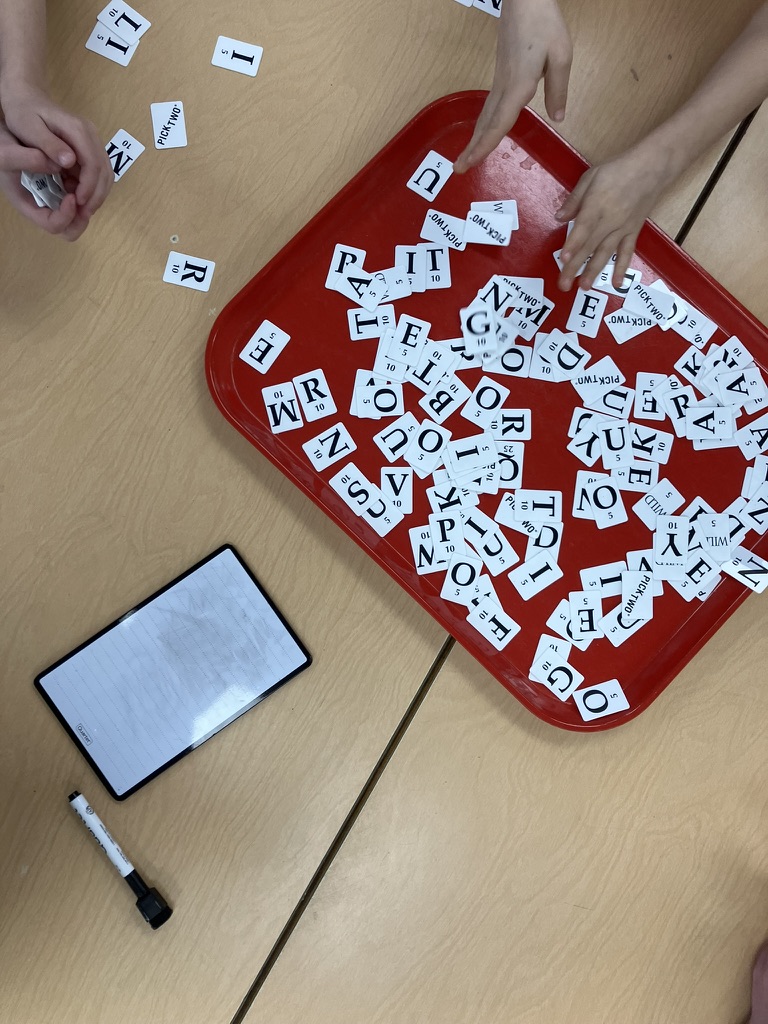
When the first group sat down at my station, I introduced myself again and asked for each student’s name. Nearly all students announced they wanted to spell their own names for their first letter tile word, but many quickly hit some speed bumps when they did not recognize the capital versions of the typically lowercase letters in their names. This task of spelling names using only capital letters seemed to be just the right amount of challenging, so I ran with this activity while encouraging students to experiment with a variety of words that they felt ready to spell. This way, I was able to connect to the B.C. Curriculum’s English Language Arts big idea “playing with language helps us discover how language works”. After spelling their own names, students spelled the names of family members, classmates, and their last names. Without any instruction on my part, students were connecting to another big idea, “through listening and speaking, we connect with others and share our world”.Then, I encouraged students to see what other words were “inside” their names (e.g., “My name is Teacher Graham, and I see the word “ham” at the end of my name”).

Two students in the final group exemplified the big idea of “playing with language” in the photo above, when they collaborated to invent a new word (which, if your interested, we agreed is pronounced “duh-nuh-mo-ee-ah”) which we worked as a team to sound out. This exciting moment where students were thinking outside the box with language reminded me that some mistakes such as my grade mix-up are really happy accidents. If I had come with the correct activity, I wouldn’t have been so open to letting students teach me.