
When I stepped into EDCI 402 on the first day of the semester, Bridget George’s beautiful illustrated cover for The Animal People Choose a Leader (Wagamese, 2024) instantly caught my eye. This high-quality storybook is now one of my favourites, and regardless of which grade I end up teaching, I’ll always keep this one in my classroom library. Before this semester I would not have imagined bringing a storybook to an intermediate classroom, much less teaching an effective and engaging lesson based on one. When I think about why that is, I recall my own elementary school experience, where picture books (particularly fiction ones) stopped being discussed or promoted after grade three. A combination of reading Read Alouds for All Learners (Ness, 2024), Sometimes Reading is Hard (Bright, 2021), and my recent in-situ experiences have shown me that it really doesn’t have to be this way. Below is the Read Aloud Planning Template (Ness, 2024) my classmate and I used to structure our three read aloud sessions in a grade six classroom, all based on The Animal People Choose a Leader of course. In between, you’ll find my notes on how the read alouds went, and what I would change going forward.


I felt a bit uncertain heading into the first classroom session, but I left feeling confident. As I mentioned earlier, I didn’t know if a picture book would resonate with this age group, but it completely did. My classmate/teaching partner came up with some fun and engaging team building exercises for the students, and I could tell from their laughs and smiles that they had fun. One thing I would change if I could do it again is that before starting the book, I’d provide a bit more explicit teaching about the Ojibwe nations that the author and illustrator call home. I was worried about taking too much time, and realized afterwards that this would’ve been very worthwhile to spend a few more minutes on. This realization hit me after I finished telling the students where Ojibwe homelands are and received blank stares. A classmate later told me that some of her students last year had not understood the distinctions between Ktunaxa culture and other Indigenous cultures, and I pieced together that the class I worked with may not yet have a nationwide frame of reference for Indigenous peoples.


One thing I enjoyed about our second session with the grade sixes is that I got to see students shine who had been more reserved in the previous activities. I think this is partly due to the fact that my classmate and I were not strangers this time, but I also think the quieter nature of the activities helped. During the recap discussion and vocab preview, more students were making contributions to the discussion, and I could really see the gears in their brains turning. One thing I wish I had done differently in this otherwise great session is to more clearly explain the distinction between descriptive language and descriptive language that pertains to the setting of the story. Some students had written great notes to build their maps from, but many of their descriptive words included were more relevant to the characters or plot.


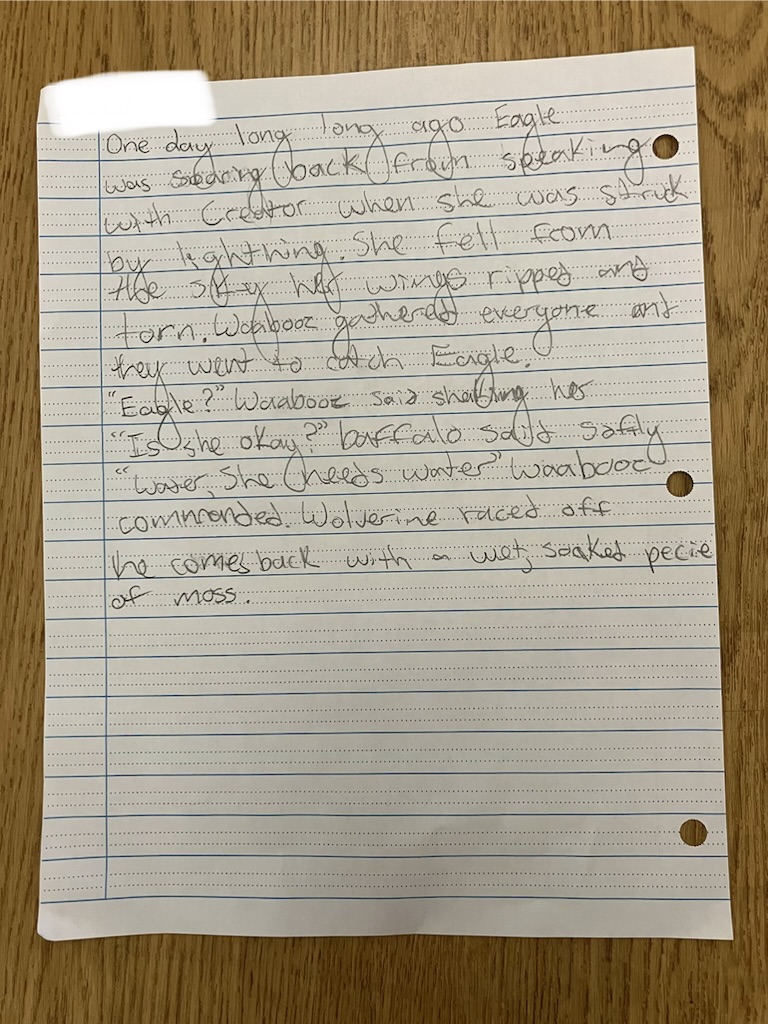
It was exciting to see the class’s understanding of the story really come together during the third and final session. At this point the student seemed to be at their most comfortable, eager to participate, and ready to learn. Although the brainstorming and the physical process of writing proved to be a challenge for a few students, with support from peers and adults everyone was able to demonstrate their learning and creativity. By the time the activity had wrapped up, nearly a third of the class wanted to come to the front to read their stories out! This made me feel like the activity was a success, because students felt proud of their work. Similarly to the previous session, one thing I would do differently next time is to make the instructions even more explicit for students. I think that providing students with instructions on paper or on the SmartBoard to refer back to after the teachers had discussed the activity might make the goals more clear to everyone as they developed their ideas. Below are some samples (used with enthusiastic student permission) of the stories the class came up with:

All in all, these three weeks were a wonderful learning experience for me and were very fun. I do hope that all future students in my program have this same opportunity, because I found it to be so valuable. Thank you to the students, teachers, and educational assistants who made this possible for us!
Leave a Reply
You must be logged in to post a comment.